

Binance USDC Outflows Reshape Stablecoin Landscape
Binance USDC outflows reached $1.8 billion after MiCA setbacks as stablecoin liquidity shifted across centralized exchanges.
- Binance USDC outflows reached $1.8 billion during Q2 as MiCA licensing challenges reshaped exchange stablecoin balances.
- Bybit posted 45% USDC growth while Binance and OKX both recorded declining tracked USDC holdings during the quarter.
- Binance retained dominant stablecoin market share despite withdrawals and broader USDC supply contraction across the ecosystem.
Binance USDC outflows drew renewed market attention after fresh data examined stablecoin movements across leading exchanges. The figures reflected changing liquidity patterns amid regulatory developments and broader supply contraction.
MiCA Developments Triggered Large Stablecoin Withdrawals
Wu Blockchain shared fresh research examining stablecoin balances across major centralized exchanges. The report centered on Binance following its MiCA licensing setback. It evaluated where departing USDC balances ultimately moved.
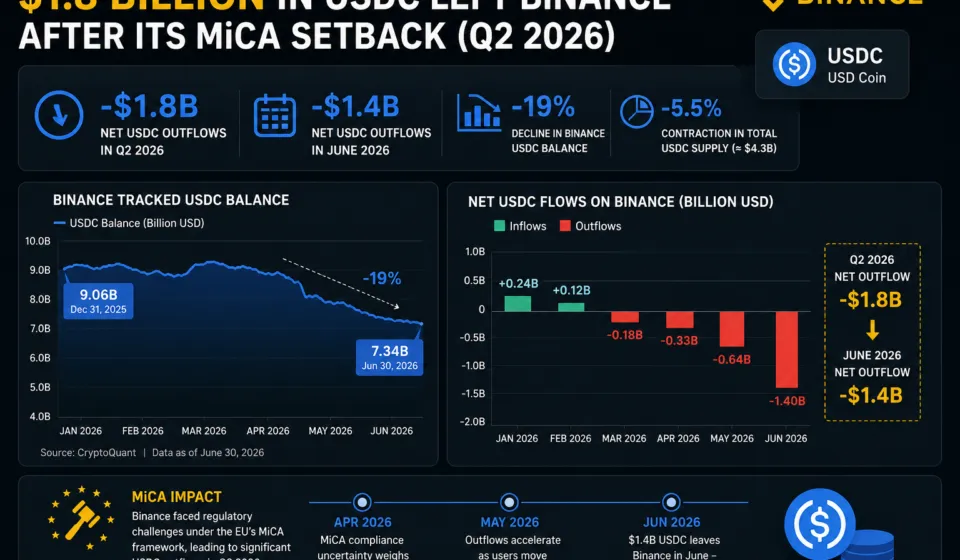
Binance recorded $1.8 billion in net USDC outflows during the second quarter. Nearly $1.4 billion of those withdrawals occurred during June alone. Tracked USDC balances on Binance also declined by 19%.
The report linked those movements with Europe’s Markets in Crypto-Assets framework. Regulatory certainty increasingly influences institutional and retail capital allocation decisions. Exchange licensing now represents another competitive factor alongside liquidity.
The accompanying illustration reinforced that relationship through symbolic market imagery. European regulation appeared separated from Binance by widening capital flows. The visual emphasized compliance becoming increasingly connected with stablecoin movement.
Exchange Competition Produced Uneven Results
The post noted Binance was not the only platform recording lower balances. OKX also experienced a 9.7% decline in tracked USDC holdings. That result challenged expectations of direct exchange-to-exchange migration.
Meanwhile, USDC experienced broader contraction across the cryptocurrency market. Total circulating supply declined 5.5% during the same reporting period. Approximately $4.3 billion worth of USDC was redeemed overall.
Those figures suggest withdrawals extended beyond centralized exchange transfers. Some investors likely redeemed stablecoins instead of relocating exchange balances. Others may have shifted assets toward decentralized platforms or private custody.
Among comparable exchanges, Bybit produced the strongest reported performance. Its tracked USDC balance climbed 45%, increasing from $450 million to $660 million. Demand for USDC-margined derivatives supported that expansion.
Binance Retains Stablecoin Leadership Despite Withdrawals
The report also examined Circle’s distribution relationship with Binance. Treasury balances appeared supported through distribution arrangements during the period. Customer balances, however, continued moving away from the platform.
That distinction separated institutional liquidity management from retail user behavior. Distribution incentives did not prevent customer withdrawals from occurring. Regulatory developments remained an important influence on stablecoin positioning.
Despite the reported withdrawals, Binance preserved substantial market leadership. The exchange still held 62% of stablecoins across eight reviewed exchanges. It also controlled roughly 80% of centralized exchange USDC balances.
The broader findings illustrate changing priorities across digital asset markets. Regulation increasingly shapes liquidity alongside trading products and incentives. Binance USDC outflows therefore reflected both exchange-specific developments and wider stablecoin market adjustments.