

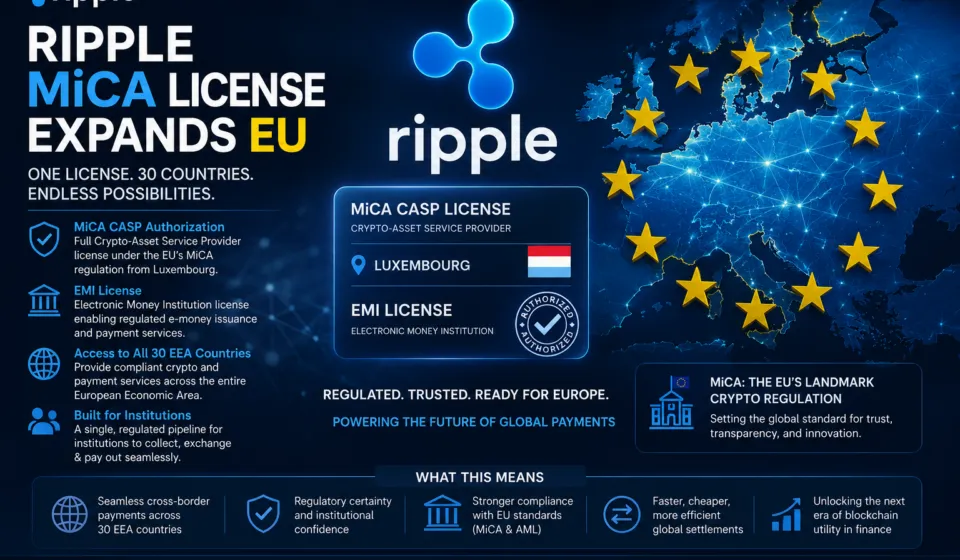
Ripple MiCA License Expands EU Payment Access
Ripple MiCA license expands regulated EEA payments as social commentary links the approval to broader XRP Ledger adoption.
- Ripple secured MiCA CASP approval and paired it with its EMI license for regulated EEA payment services across 30 markets.
- Social media commentary linked Ripple’s approval to broader European digital finance plans without official regulatory confirmation.
- Ripple stated regulatory clarity supports institutional trust while expanding compliant payment infrastructure across the European market.
Ripple MiCA License marks a new regulatory milestone after Ripple secured MiCA CASP authorization in Luxembourg. The approval expands regulated payment capabilities across the 30-member European Economic Area through Ripple Payments.
Ripple Secures Expanded European Authorization
Ripple announced its MiCA CASP authorization through an official social media post. The company received approval from Luxembourg’s financial regulator, the CSSF. The authorization complements Ripple’s existing Electronic Money Institution license.
Ripple stated institutions can collect, exchange, and distribute payments through one framework. The arrangement covers all 30 European Economic Area member states. The company described regulatory clarity as institutional trust’s foundation.
The announcement focused on regulated financial infrastructure rather than cryptocurrency speculation. Ripple emphasized operational efficiency for enterprise payment customers. The message targeted banks, payment providers, and regulated financial institutions.
The official post did not reference XRP price movements. XRP traded around $1.08 during the broader market discussion. The announcement instead centered on compliance and payment network expansion.
Social Commentary Extends the Narrative
Following Ripple’s announcement, Stellar Rippler shared an extensive interpretation on X. The post described the authorization as a transformational European development. It characterized Ripple as the region’s emerging digital payment infrastructure.
The commentary claimed Ripple effectively became the new SWIFT for digital assets. That statement reflected the author’s interpretation rather than Ripple’s announcement. The official communication contained no such declaration.
The social media thread also referenced claims attributed to Lord Belgrave. Those statements suggested European planning involved XRP Ledger infrastructure. They further described regulatory alignment developing over several years.
The thread connected Digital Euro planning with institutional custody and cross-border settlement. It also mentioned escrow liquidity and expiring non-disclosure agreements. None of those claims appeared within Ripple’s official announcement.
Regulatory Approval and Market Interpretation
Ripple confirmed institutions can operate through one regulated relationship across participating markets. That structure may simplify compliance for eligible financial organizations. MiCA creates a common regulatory framework across the European Union.
The company presented the authorization as a practical business milestone. Its communication remained focused on licensed financial services. It avoided broader claims regarding European financial system leadership.
Social media users connected the approval with future XRP Ledger adoption. Those discussions remain separate from confirmed regulatory announcements. European authorities have not publicly designated XRP Ledger for Digital Euro settlement.
The available information confirms Ripple expanded its regulated European presence. Commentary surrounding wider institutional integration remains speculative. Market participants will likely monitor future regulatory announcements for additional developments.