

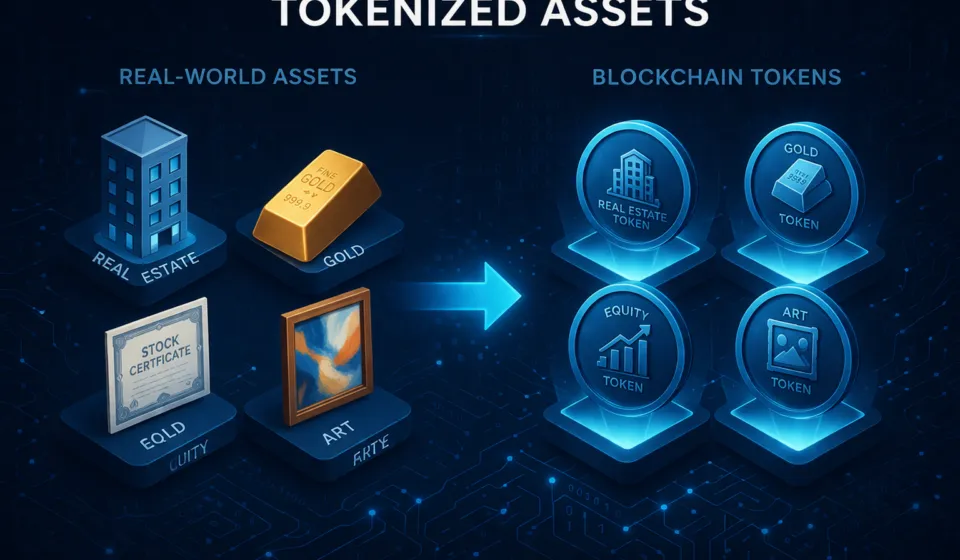
Tokenized Assets Surge Toward Institutional Adoption
Tokenized Assets gain traction as institutions like Franklin Templeton and NYSE back blockchain integration and on-chain financial products.
- Institutional adoption accelerates as major firms expand blockchain-based financial products across global markets.
- Tokenized markets show steady growth while traditional asset classes reflect slower capital expansion trends.
- Bitcoin gains attention as a potential settlement layer supporting large-scale tokenized financial ecosystems.
Tokenized Assets are gaining momentum as institutional players expand blockchain integration, signaling a shift in global finance structures. Market projections estimate tokenized stocks could approach $1 trillion by 2026, driven by increasing adoption.
Institutional Momentum Builds Across Financial Markets
Recent commentary from CryptosRus emphasized the accelerating pace of tokenization across markets. The post noted strong institutional participation alongside expanding blockchain infrastructure. This aligns with broader forecasts pointing toward large-scale adoption.
The update referenced activity from Franklin Templeton, which manages approximately $1.7 trillion in assets. The firm is actively rolling out on-chain exchange-traded funds across blockchain networks. These developments signal a shift from experimentation to execution.
At the same time, New York Stock Exchange has partnered with Securitize. This collaboration reflects increasing integration between traditional exchanges and blockchain-based platforms. The move aims to streamline access to tokenized securities.
The chart reflects these developments through gradual upward trends in blockchain-aligned segments. Traditional asset classes appear comparatively stable during the same period. This divergence suggests capital allocation patterns are changing steadily.
Capital Rotation Signals Structural Market Shift
The chart outlines distinct performance differences between equity indices and emerging tokenized markets. While equities maintain consistency, tokenized assets show progressive expansion. This indicates a transition in how capital is being distributed globally.
Private equity and venture capital segments also demonstrate slower relative growth patterns. In contrast, blockchain-based assets are gaining visibility within institutional portfolios. This shift suggests evolving preferences in long-term investment strategies.
The timeline within the chart presents early-stage growth characteristics. Tokenized assets remain at a lower baseline compared to traditional equities. However, the steady incline indicates increasing adoption over time.
Such patterns mirror earlier technological adoption cycles observed in financial markets. Initial growth phases often appear gradual before broader expansion occurs. The chart supports this progression through consistent upward movement.
Bitcoin Positioned Within Tokenization Framework
The discussion also addressed the role of Bitcoin within this evolving structure. It is being considered as a potential settlement layer for tokenized transactions. Its decentralized framework supports secure and transparent processing.
Market participants are evaluating how blockchain networks can support large-scale financial operations. Bitcoin’s established infrastructure makes it relevant in these discussions. Its role extends beyond traditional use cases as adoption expands.
Additionally, Nouriel Roubini acknowledged tokenization as a bridge between financial systems. This statement reflects growing recognition from established economic voices. Such perspectives indicate broader acceptance of blockchain integration.
The chart reinforces this narrative through visible shifts in asset behavior. Tokenized markets continue to expand alongside increasing institutional participation. These developments point toward gradual integration rather than sudden transformation.