

Tokenized RWA Growth Accelerates Across Crypto Markets
Tokenized RWA Growth could reach $2 trillion by 2028 as institutions expand blockchain settlement and yield-focused financial products.
- Tokenized RWA Growth projections reached $2 trillion by 2028 across institutional blockchain infrastructure markets.
- Financial firms increasingly explored tokenized treasuries, private credit, and blockchain-based settlement frameworks globally.
- Institutional demand continued supporting regulated RWA platforms focused on compliant yield-generating digital asset products.
Tokenized RWA Growth accelerated across crypto markets as institutional firms expanded blockchain-based financial infrastructure. Standard Chartered projected tokenized real-world assets could approach nearly $2 trillion before 2028.
Institutional RWA Expansion Gains Momentum
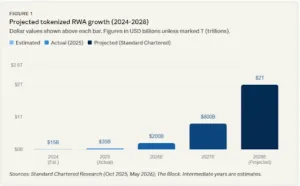
Standard Chartered projected tokenized real-world assets reaching approximately $35 billion during 2025 recently. Estimates then accelerated sharply toward nearly $200 billion during projected 2026 market expansion.
CryptoBusy discussed the growing RWA market opportunity through a recent post on X. The update connected tokenization growth with institutional blockchain adoption and regulated yield demand.
Source: X
The chart projected tokenized markets reaching approximately $800 billion during the 2027 expansion phase. Forecasts eventually estimated the broader tokenized asset sector approaching nearly $2 trillion during 2028.
Earlier growth phases remained relatively modest between 2024 and 2025 across tokenized asset infrastructure markets. That period reflected institutional experimentation rather than aggressive capital deployment into blockchain settlement systems.
Financial institutions historically expanded cautiously during infrastructure transition cycles across traditional capital markets globally. Regulatory frameworks, custody systems, and compliance standards required extensive operational coordination beforehand.
The projected acceleration beginning during 2026 changed the broader RWA market structure considerably afterward. Exponential growth curves typically emerge after operational bottlenecks gradually weaken across developing infrastructure sectors.
Tokenized Yield Products Attract Institutions
Tokenized RWA Growth increasingly centered around yield-generating blockchain financial products across institutional markets recently. Traditional finance participants continued favoring stable cash-flow structures over speculative digital asset exposure.
Tokenized treasury products therefore emerged as major institutional gateways into blockchain ecosystems globally recently. Private credit, real estate exposure, and yield-bearing instruments also gained stronger institutional attention afterward.
Institutions increasingly evaluated blockchain systems as settlement infrastructure rather than speculative trading networks recently. Market participants explored operational efficiency improvements through tokenized ownership and collateral mobility frameworks.
Ondo Finance positioned heavily around tokenized treasury exposure and institutional-grade blockchain yield products recently. Centrifuge focused more directly on bringing private credit infrastructure onto blockchain settlement systems.
Goldfinch expanded decentralized credit infrastructure while MANTRA emphasized regulated RWA market frameworks globally recently. Those projects approached tokenization from different infrastructure segments instead of narrow competitive positioning strategies.
BackedFi and MapProtocol also remained active across expanding blockchain-based tokenized asset infrastructure markets recently. Institutional demand increasingly favored platforms supporting regulated operational structures and compliant settlement frameworks globally.
Blockchain Infrastructure Adoption Continues Rising
Tokenized RWA Growth also aligned with broader institutional blockchain infrastructure expansion globally recently. Banks, payment firms, and asset managers increasingly explored stablecoin settlement systems simultaneously.
Improving interoperability standards strengthened institutional confidence surrounding blockchain-based financial infrastructure systems recently. Custody technology also matured steadily across tokenized securities and settlement-related operational environments globally.
Large financial institutions rarely allocate substantial resources toward operationally irrelevant technology infrastructure historically. Growing tokenization participation suggested blockchain systems increasingly matched institutional financial architecture requirements globally.
However, execution risks still remained across expanding tokenized asset infrastructure markets recently. Regulatory fragmentation and cybersecurity concerns continued affecting broader institutional blockchain adoption strategies worldwide.
Liquidity limitations and jurisdictional inconsistencies also remained unresolved across several tokenized market segments currently. Institutional participation may therefore expand unevenly despite aggressive long-term tokenization growth projections globally.
The broader market increasingly viewed tokenization as productive financial infrastructure rather than speculative experimentation recently. Blockchain systems continued facilitating ownership transfer, settlement efficiency, and yield distribution across traditional financial assets.