


Bitcoin ETF Outflows Reach $1.28B as Demand Weakens
Bitcoin ETF outflows reach $1.28 billion weekly as institutional demand weakens, while BTC holds near its closely watched 50-week average.
- Bitcoin ETFs recorded $1.28 billion in weekly withdrawals, with Friday contributing another $411.9 million to institutional selling pressure.
- Bitcoin continues holding near its 50-week moving average despite weaker ETF demand and uncertainty across financial markets.
- Ethereum and Solana ETFs also recorded withdrawals, while three-month net flows remained positive at $151.30 million.
Bitcoin ETF outflows are accelerating as institutional demand weakens, raising questions about investor confidence and Bitcoin’s ability to defend long-term technical support.
Institutional Withdrawals Put Bitcoin ETFs Under Pressure
CryptosRus reports that Bitcoin ETFs recorded $1.28 billion in weekly net outflows. Friday contributed another $411.9 million in withdrawals, extending the recent selling pressure. The development followed political uncertainty, technology stock volatility, and lingering Binance hack concerns.
Source: X(@CryptosR_Us)
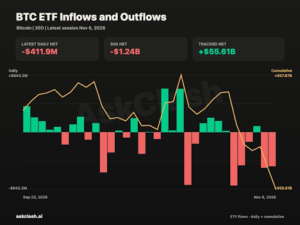
The accompanying 30-day chart tracks substantial fluctuations in institutional investment activity. Its latest reading shows negative $411.9 million in daily Bitcoin ETF flows. Meanwhile, cumulative net flows declined towards $55.61 billion by November 6.
The historical figures reveal that withdrawals have become increasingly pronounced. Earlier sessions recorded several positive inflows, particularly around October 19 and October 21. However, subsequent selling erased much of that progress.
The cumulative flow line also shows the extent of this reversal. It previously approached approximately $57.87 billion before turning lower. Repeated withdrawals subsequently reduced the accumulated total across the reporting period.
Bitcoin Leads Withdrawals Across Cryptocurrency Investment Products
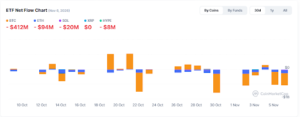
The broader ETF dashboard provides additional details about institutional positioning. Its November 6 reading records combined daily net outflows of $533.75 million. Bitcoin accounts for approximately $412 million, making it the largest contributor.
Source: Coinmarketcap
Ethereum follows with $94 million in withdrawals during the same session. Solana records another $20 million, while XRP and HYPE show zero net flows. These figures indicate that selling extended beyond Bitcoin investment products.
Historical measurements also reveal pressure across shorter reporting periods. Weekly net flows stand at negative $788.70 million, while monthly withdrawals reach $644.30 million. However, three-month net flows remain positive at $151.30 million.
The dashboard’s yearly figures provide another perspective on changing demand. August recorded the strongest monthly performance, attracting $5.48 billion. June represented the weakest month, with withdrawals reaching $5.08 billion.
Bitcoin’s 50-Week Moving Average Remains Important
Despite the withdrawals, Bitcoin continues holding near its 50-week moving average. This long-term technical level remains closely watched during the current market weakness. Its ability to hold could influence how traders assess subsequent price movements.
The contrast between ETF flows and price behaviour deserves particular attention. Institutional withdrawals indicate reduced exposure through these investment products. However, they do not establish that every Bitcoin investor is selling.
Market conditions have also contributed to the recent uncertainty. Political developments and technology stock volatility have affected investor sentiment. Lingering concerns following the Binance hack have added another source of caution.
For Bitcoin, renewed ETF inflows would provide evidence of recovering institutional demand. Continued withdrawals could instead maintain pressure on the investment products. The 50-week moving average remains a key technical reference during this period.
The available figures therefore present two competing market developments. Institutional demand has weakened, although Bitcoin retains its position near long-term technical support. Whether buyers defend that level remains central to the next market direction.