

Ethereum DeFi Dominance Holds 53.54% Market Share
Ethereum DeFi dominance reaches 53.54% of total TVL, as competing blockchain networks struggle to match its liquidity and ecosystem size.
- Ethereum controls 53.54% of DeFi TVL, maintaining a substantial lead over Base, Solana, BSC, and other competing blockchain networks.
- Base holds 7.21%, while Solana, BSC, and Tron account for smaller shares of decentralized finance capital.
- Established protocols, deep liquidity, stablecoins, tokenized assets, and developer activity continue supporting Ethereum’s position across decentralized finance.
Ethereum DeFi dominance remains pronounced, with the network holding 53.54% of total value locked as rival chains divide a much smaller share of decentralized finance capital across the wider ecosystem.
Ethereum Maintains a commanding Lead in DeFi Capital
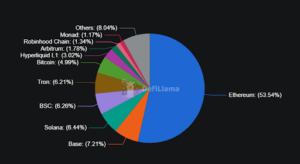
Lucky (@LLuciano_BTC) argues that Ethereum’s strength remains underestimated despite increasing competition across cryptocurrency markets. His observation focuses on Ethereum holding more than 53% of decentralized finance’s total value locked. The accompanying DeFiLlama chart places its exact share at 53.54%.
Source: X(@LLuciano_BTC)
This allocation puts Ethereum considerably ahead of every competing blockchain. Its closest individual competitor, Base, accounts for just 7.21% of total TVL. Ethereum therefore holds more than seven times Base’s displayed market share.
The difference becomes clearer when several competing networks are combined. Base, Solana, BSC, and Tron collectively account for 26.12%. Ethereum alone maintains more than twice their combined allocation.
Such concentration reflects the amount of capital residing within Ethereum’s decentralized finance infrastructure. Its established protocols provide services across lending, borrowing, trading, and liquidity provision. These applications continue attracting substantial capital from cryptocurrency participants.
Competing Blockchains Maintain Smaller TVL Shares
Base occupies second position with 7.21% of the displayed distribution. Solana follows at 6.44%, while BSC accounts for 6.26%. Tron comes closely behind with a 6.21% share of total TVL.
Bitcoin represents another 4.99% of the distribution. Hyperliquid L1 follows with 3.02%, while Arbitrum accounts for 1.78%. Robinhood Chain and Monad hold smaller allocations of 1.34% and 1.17%, respectively.
The remaining blockchain networks collectively represent 8.04% of total value locked. This category demonstrates that decentralized finance extends beyond the individually listed networks. However, their combined presence does not challenge Ethereum’s leading position.
The relatively narrow differences between several competitors reveal another market development. Base, Solana, BSC, and Tron maintain comparable portions of decentralized finance capital. Their positions demonstrate that competition remains active despite Ethereum’s considerable lead.
Liquidity and Network Development Support Ethereum’s Position
Lucky attributes Ethereum’s position to years of development, adoption, and established network effects. He also identifies deep liquidity, major protocols, and developer participation. Stablecoins, real-world assets, and institutional interest form additional parts of his argument.
Liquidity remains particularly important across decentralized finance applications. Larger capital pools can support trading activity and lending operations. They also provide participants with access to established financial services.
Ethereum’s extensive protocol infrastructure contributes to its continued presence across DeFi markets. Developers have built applications supporting several financial activities on the network. Consequently, its TVL position reflects accumulated participation across multiple application categories.
Nevertheless, the chart measures deposited capital rather than every aspect of network adoption. Transaction activity, security, developer numbers, and user participation require separate measurements. Therefore, its 53.54% share should not represent a complete assessment of blockchain performance.
Competition also remains relevant as alternative networks continue attracting capital. Base, Solana, BSC, and Tron have established measurable positions within decentralized finance. Their future growth could gradually change the distribution shown in subsequent TVL readings.
For now, Ethereum retains the largest share by a considerable margin. Its established liquidity and application base distinguish it from individual competitors. The latest DeFiLlama figures provide measurable evidence of that position.
The figures also support the central point raised by Lucky. Ethereum’s standing extends beyond short-term market narratives and price movements. Its current DeFi footprint reflects years of development and capital participation.