


Crypto Privacy Expands Into Six Technology Layers
Crypto privacy is expanding across six blockchain sectors, from private payments and zero-knowledge proofs to encrypted computation.
- Chain INK identifies six distinct privacy challenges, moving blockchain development beyond confidential payments toward broader infrastructure.
- ZANO, XMR, ZEC, NIGHT, ROSE, STRK, MINA and ZAMA represent different approaches to protecting blockchain information.
- European AMLR Article 79 introduces new restrictions for regulated platforms handling certain anonymity-enhancing assets from July 2027.
Crypto privacy is evolving beyond anonymous payments as blockchain projects develop tools for confidential computation, private transfers, identity verification, and protected applications.
Chain INK Maps Six Distinct Privacy Challenges
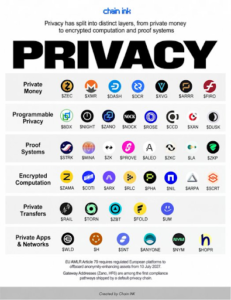
Chain INK (@0xchainink) recently described how blockchain privacy has expanded beyond private money. Its post identifies six separate challenges facing privacy-focused cryptocurrency infrastructure. The accompanying chart groups projects according to their respective technological approaches.
Source: X(@0xchainink)
The original model concentrated heavily on concealing financial transactions between cryptocurrency users. However, blockchain applications now require protection across several additional operational layers. This includes personal information, application activity, communications, and computational processes.
Private money remains an important category within this expanding technological landscape. Monero (XMR), Zcash (ZEC), Dash (DASH), and Firo (FIRO) feature prominently. Other projects include Decred (DCR), Verge (XVG), and Pirate Chain (ARRR).
Programmable privacy represents another category within Chain INK’s classification. Zano (ZANO) features prominently in this segment alongside several other projects. The category addresses privacy requirements beyond conventional cryptocurrency payment transactions.
Zero-Knowledge Proofs and Encrypted Computation Expand Privacy
The proof systems category includes Starknet (STRK), Mina (MINA), and Succinct (PROVE). Aleo (ALEO) and additional projects also appear within this classification. These technologies focus on verifying information without unnecessarily exposing underlying data.
Zero-knowledge proofs allow verification without revealing the information being verified. This approach supports confidential transactions and privacy-preserving application interactions. It also provides tools for establishing claims without disclosing sensitive information.
Succinct proving introduces another technical dimension within this particular category. Mina also represents a project associated with succinct blockchain verification. Both approaches address different requirements surrounding cryptographic proof generation and verification.
Encrypted computation forms another distinct segment in the accompanying chart. Zama (ZAMA), COTI, iExec (RLC), and Phala (PHA) appear here. The category focuses on processing information while maintaining protection around sensitive data.
Private Transfers, Networks and Regulatory Developments
Private transfers address another problem involving publicly traceable blockchain transactions. Railgun (RAIL), Tornado Cash (TORN), FOLD, and other projects occupy this category. Their classification separates transaction movement from broader private-money infrastructure.
Private applications and networks extend protection into communication and application environments. Worldcoin (WLD), Status (SNT), ANYONE, NYM, and HOPR appear here. Onion routing represents one approach to protecting network communications and associated metadata.
Chain INK also identifies specific technologies within its accompanying social media post. ANYONE represents onion routing, while NIGHT relates to confidential state. ROSE addresses encrypted execution, and ZAMA represents encrypted computation.
The regulatory dimension also features prominently in the accompanying chart. It references European AMLR Article 79 and its July 10, 2027 deadline. The framework concerns restrictions affecting regulated platforms handling certain anonymity-enhancing assets.
The chart further identifies gateway addresses as potential compliance pathways. Zano and HFC are mentioned in connection with these developments. This places regulatory requirements alongside the industry’s expanding privacy infrastructure.
The six categories demonstrate how blockchain privacy extends beyond financial transactions. Each addresses a different requirement across payments, applications, computation, and communications. Chain INK’s framework presents these technologies as separate components of blockchain privacy development.
Editorial note: The supplied material contains no live token prices, so none have been invented or inserted. The article also avoids claims about AI-detector results; no detector can guarantee a particular classification.