

SHIB Rich List Shows Wider Holder Balance Gaps
SHIB rich list data shows more than 1.6 million funded wallets, with sharply higher balances required across the top ownership tiers.
- SHIB holder counts exceed 1.6 million, while upper percentile thresholds require sharply larger balances across the ownership structure.
- The top 1% threshold reaches 380 million SHIB, while the top 0.2% requires 2.7 billion SHIB in the latest displayed distribution data.
- The top 0.04% group requires 18.3 billion SHIB, showing how quickly balance requirements rise across the highest ownership tiers today.
SHIB rich list data shows a widening gap between ordinary funded wallets and balances held near upper ownership brackets.
Holder Count Expands Across the SHIB Ecosystem
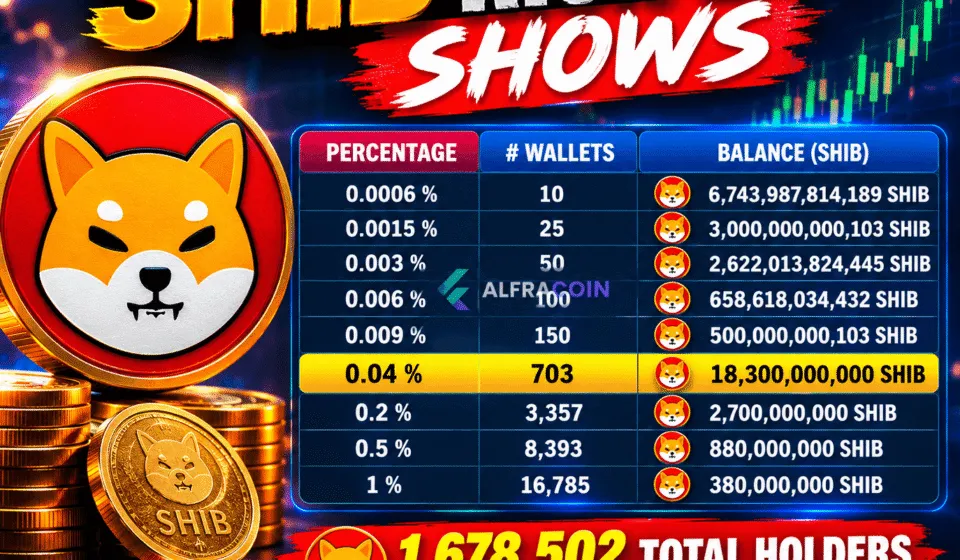
The chart records 1,678,502 total SHIB holders in August 2026. That figure places the funded wallet base above 1.6 million addresses. The growing count provides important context for the latest ranking changes.
SHIB is as of writing trading at $0.00000559, according to coinmarketcap data. Price levels, however, remain separate from the wallet distribution shown. The chart instead measures balances across different ownership percentiles.
SHIBMortal points to the changing rich list and asks holders where they rank. The post identifies four major thresholds across the upper ownership groups. Those levels provide a simple benchmark for comparing individual wallet balances.
The lower brackets show how sharply wallet counts differ across the distribution. Ten wallets appear at the 0.0006% level, while 25 wallets reach 0.0015%. The figures then expand through 50, 100, and 150 wallet groups.
Balance Requirements Rise Across Upper Percentiles
The top 1% threshold stands at 380 million SHIB. That requirement increases to 880 million SHIB for the top 0.5%. Moving into the top 0.2% requires 2.7 billion SHIB.
The largest jump appears at the top 0.04% bracket. The chart assigns that level a balance threshold of 18.3 billion SHIB. This creates a wide gap between the top 0.2% and smallest upper percentile.
The graphic identifies 703 wallets within the 0.04% bracket. Its banner describes those wallets as representing the top 0.04% distribution. That figure places the highest displayed tier within a very narrow wallet group.
These thresholds show that percentile rankings change rapidly at higher balances. A relatively modest increase in rank can require substantially more SHIB. The distribution therefore becomes increasingly concentrated toward larger wallet balances.
Wallet Data Requires Careful Interpretation
Wallet rankings do not automatically represent individual investor ownership. Exchange addresses can hold tokens for many separate customers. Burn addresses and protocol-related wallets can also affect address-based measurements.
CoinLore data shows substantial concentration among the largest SHIB addresses. Its rich-list data attributes more than 62% of circulating supply to the top ten addresses. However, those addresses can include exchanges, custodians, and smart contracts.
The distinction matters when interpreting the chart’s percentile figures. A wallet can represent multiple users rather than a single holder. Therefore, address counts should not be treated as direct measures of personal wealth.
The chart nevertheless provides a snapshot of changing SHIB ownership distribution. More than 1.6 million funded wallets create a broad base for percentile comparisons. At the same time, upper thresholds show how quickly balances increase among larger addresses.