


Bitcoin ETF Inflows Reverse as Institutions Buy
Bitcoin ETF inflows reversed on September 2 as $101.1 million entered, with BlackRock’s IBIT leading renewed institutional demand.
- September ETF flows reversed sharply, with $101.1 million entering after $236.5 million left the market during the prior session today.
- BlackRock’s IBIT attracted $115.4 million, exceeding the sector’s net inflow while other funds recorded withdrawals during trading.
- Bitcoin traded above $80,000 as renewed ETF demand emerged, keeping institutional positioning central to the latest market recovery.
Bitcoin ETF inflows returned to positive territory after a sharp daily reversal, while renewed institutional buying drew attention to demand during Bitcoin’s latest market recovery across markets.
ETF flows reverse after September outflows
U.S. spot Bitcoin ETFs recorded $101.1 million in net inflows September 2. That followed $236.5 million in net outflows during the previous session. The reversal changed the short-term flow picture across regulated Bitcoin investment products.
BlackRock’s IBIT accounted for $115.4 million of the reported inflows. Its intake exceeded the combined net result across the ETF group. Other funds therefore recorded enough withdrawals to reduce the sector total.
The move came as Bitcoin traded above $80,000 in current market reporting. Earlier September trading placed Bitcoin near the high-$77,000 area. Price recovery therefore coincided with renewed demand through exchange-traded products.
The latest reversal also fits the longer chart’s volatile pattern. Green inflow bars repeatedly appeared alongside major Bitcoin price advances. However, red outflow periods also emerged during several market pullbacks.
Institutional demand remains uneven
The chart shows large inflow spikes throughout 2024 and 2025. Those buying periods frequently accompanied stronger Bitcoin price movements. Still, the relationship between flows and price remained inconsistent across periods.
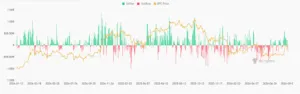
Source: Coinglass
During late 2024, repeated inflows coincided with Bitcoin’s sharp price acceleration. The pattern demonstrated stronger demand through regulated investment channels. Meanwhile, withdrawals continued appearing between individual accumulation sessions.
Mid-to-late 2025 produced another dense sequence of positive flow readings. Bitcoin also traded near elevated levels during that period. Later price weakness showed that ETF demand alone cannot determine market direction.
Market structure remained dependent on liquidity, leverage, and broader investor positioning. ETF flows provide useful evidence about capital entering regulated Bitcoin vehicles. They do not independently establish a sustained bullish or bearish trend.
The 2026 chart shows more frequent alternation between inflows and outflows. Several sizeable green bars appeared despite periods of weaker Bitcoin prices. That pattern indicates continued participation alongside changing short-term positioning.
September reversal puts flows back in focus
The September 2 inflow arrived immediately after heavy selling pressure. That timing places greater attention on whether positive flows can persist. A single session remains less conclusive than several consecutive inflow days.
August reportedly generated about $3.5 billion through Bitcoin ETFs. That represented the strongest monthly inflow since July 2025. The September reversal therefore followed a substantial recent period of institutional demand.
BlackRock’s IBIT remained central to the latest daily accumulation. Its $115.4 million inflow represented more than the sector’s final net gain. GBTC recorded a $56.2 million outflow during the same session.
The chart also shows why sustained buying deserves closer monitoring. Persistent green bars alongside resilient prices would provide stronger confirmation. Conversely, renewed red bars could signal another period of distribution.
The broader data points to an institutional market still actively adjusting exposure. Bitcoin’s movement above $80,000 has occurred alongside renewed ETF demand. Future sessions will show whether September’s reversal develops into a broader accumulation phase.