
Ripple Connections Span Seven Top Global Banks
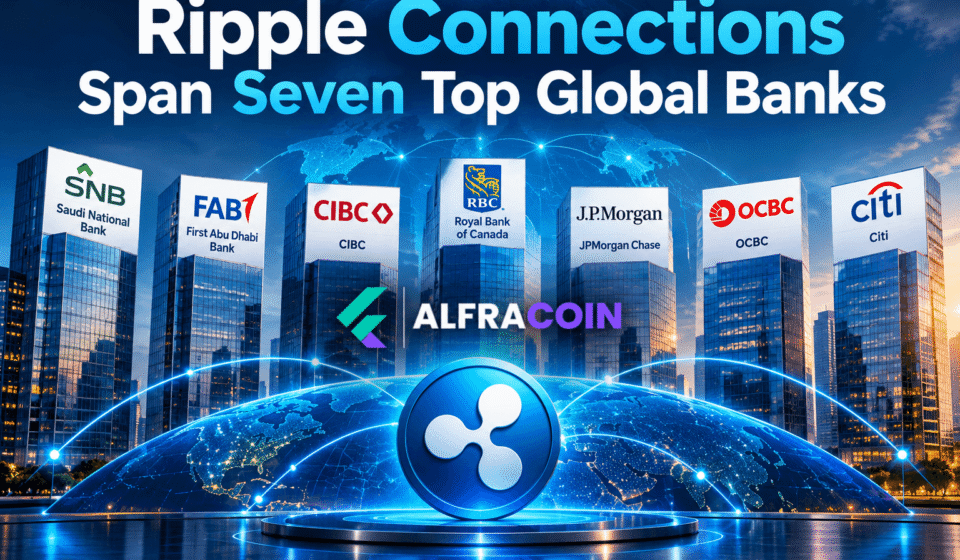
Ripple connections span seven of the world’s ten strongest banks, covering cross-border payments, treasury services, and digital asset custody.
- Seven of the world’s ten strongest banks have documented Ripple connections across payments, treasury connectivity, and digital asset custody.
- Saudi National Bank, CIBC, and First Abu Dhabi Bank feature among institutions linked to Ripple’s cross-border payment technology.
- JPMorgan Chase, OCBC, and Citi have separate connections involving treasury data, bank connectivity, and digital asset custody services.
Ripple connections feature among seven of the world’s ten strongest banks, according to The Asian Banker’s 2026 global banking ranking released recently.
Seven Leading Banks Have Documented Ripple Connections
SMQKE (@SMQKEDQG) shared the ranking and identified seven banks with documented Ripple connections. The list includes Saudi National Bank, First Abu Dhabi Bank, CIBC, and Royal Bank of Canada. JPMorgan Chase, OCBC, and Citi complete the group of institutions identified in the post.
Source: X(@SMQKEDQG)
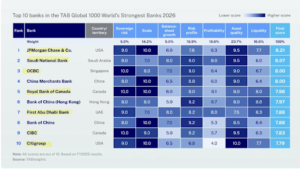
The Asian Banker released its TAB Global 1000 World’s Strongest Banks 2026 ranking. The assessment compares institutions using several financial strength and operational performance indicators. These include sovereign risk, scale, balance sheet growth, risk profile, profitability, and asset quality.
The accompanying chart presents individual scores across these six assessment categories. Scores vary between institutions, reflecting differences in their financial profiles and operating environments. The ranking evaluates banking strength independently of relationships with blockchain technology providers.
According to SMQKE, each institution has an identifiable connection to Ripple or its business ecosystem. These relationships cover payment services, treasury connectivity, institutional coordination, and digital asset custody. However, the specific arrangements differ across the seven banks.
Payment Networks Connect Banks Across Markets
Saudi National Bank appears on the list through its reported participation in RippleNet. RippleNet was designed to connect financial institutions and facilitate cross-border payment services. Its inclusion demonstrates the relationship between the bank and Ripple’s payment network.
First Abu Dhabi Bank also features among the institutions identified in the post. SMQKE describes it as the first bank in the Middle East to go live on Ripple. The reported connection places the institution within Ripple’s international payments network.
Canadian banks account for two additional relationships in the list. CIBC adopted Ripple technology for cross-border payments, according to the shared information. Royal Bank of Canada was identified as a founding member of Ripple’s Global Payments Steering Group.
These examples represent different forms of institutional engagement with Ripple’s payment infrastructure. CIBC’s connection concerns payment technology, while RBC’s involves participation in an industry steering group. Neither relationship alone establishes the extent of any current XRP usage.
Treasury Connectivity and Digital Asset Custody
JPMorgan Chase and OCBC represent the treasury-related connections identified by SMQKE. JPMorgan Chase reportedly provides account data feeds into Ripple Treasury. OCBC, meanwhile, was named within Ripple Treasury’s bank connectivity network.
These arrangements concern financial data access and connectivity between banking systems. Treasury services support institutions in managing financial information and related operational activities. The relationships differ from RippleNet’s focus on cross-border payment connectivity.
Citi’s connection involves digital asset custody technology through Metaco. The bank selected Metaco for digital asset custody before Ripple acquired the company. That acquisition brought Metaco into Ripple’s corporate ecosystem.
The seven relationships span several areas of institutional financial infrastructure. However, the ranking and accompanying post do not establish that every bank uses XRP. They also do not confirm that every relationship involves the XRP Ledger or cryptocurrency transactions.
The reported connections therefore concern distinct products, services, and corporate relationships. The available information identifies the institutions involved without establishing uniform adoption across their operations. Each bank’s relationship with Ripple must be understood within its specific context.