


Fed Liquidity Shift Signals Crypto Market Momentum
Fed liquidity shift turns positive as balance sheet expands, signaling renewed risk appetite and potential crypto market momentum ahead.
- Fed balance sheet expansion signals liquidity reversal after prolonged tightening phase across financial markets globally.
- Historical trends show liquidity expansion often aligns with strong rallies in crypto and broader risk assets.
- Market response depends on timing as macro factors may delay immediate price acceleration across digital assets.
Fed liquidity shift is drawing attention as new data indicates a reversal in monetary conditions, with the central bank’s balance sheet expanding after a prolonged contraction phase.
Liquidity Reversal Gains Market Attention
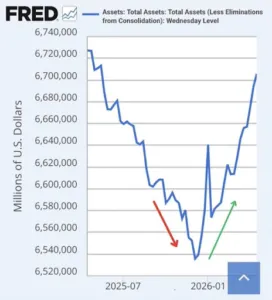
The latest data from the Federal Reserve Bank of St. Louis shows a shift in balance sheet direction. The trend moved upward after a steady decline through 2024 and 2025. This change signals a pause in liquidity withdrawal.
Source: tweeter (X)
The balance sheet had contracted under quantitative tightening policies from the Federal Reserve. During that period, liquidity conditions tightened across global markets. Risk assets faced sustained pressure as capital availability decreased.
A tweet by Crypto Tice described the move as a decisive reversal. The post stated that liquidity is expanding again after two years of contraction. It also noted that similar conditions previously supported strong asset rallies.
The chart reflects a bottoming structure before the recent move higher. The decline slowed before a sharp upward reaction. This pattern suggests a shift in monetary direction rather than temporary fluctuation.
Historical Patterns and Market Response
Previous cycles provide context for the current Fed liquidity shift. In 2019, balance sheet expansion followed funding stress in short-term markets. That phase preceded a broader rally across risk assets.
Another example emerged during the 2020 global crisis response. The central bank expanded its balance sheet rapidly to stabilize markets. That period coincided with a strong recovery in equities and digital assets.
The tweet emphasized that crypto often reacts faster than traditional markets. Liquidity inflows tend to move toward higher volatility sectors first. Digital assets have historically shown amplified responses during such phases.
Market behavior typically follows a sequence tied to liquidity conditions. Contraction periods reduce risk exposure and suppress valuations. Expansion phases, however, support renewed capital flows into speculative assets.
Structural Shift and Market Positioning
The recent upward move appears sharp compared to earlier phases. The balance sheet increase suggests more than a passive slowdown in tightening. It indicates active liquidity reintroduction into the financial system.
Such movements can reflect underlying stress in funding markets. They may also signal adjustments in policy execution. Regardless of the cause, the effect remains tied to broader liquidity availability.
Crypto markets often respond to these shifts with increased activity. Capital rotation tends to favor assets with higher growth expectations. This pattern has appeared consistently during past liquidity expansions.
Timing remains a key factor in market reaction. Liquidity changes may take time to translate into sustained price movements. External conditions, including rates and inflation, can influence the pace of response.