

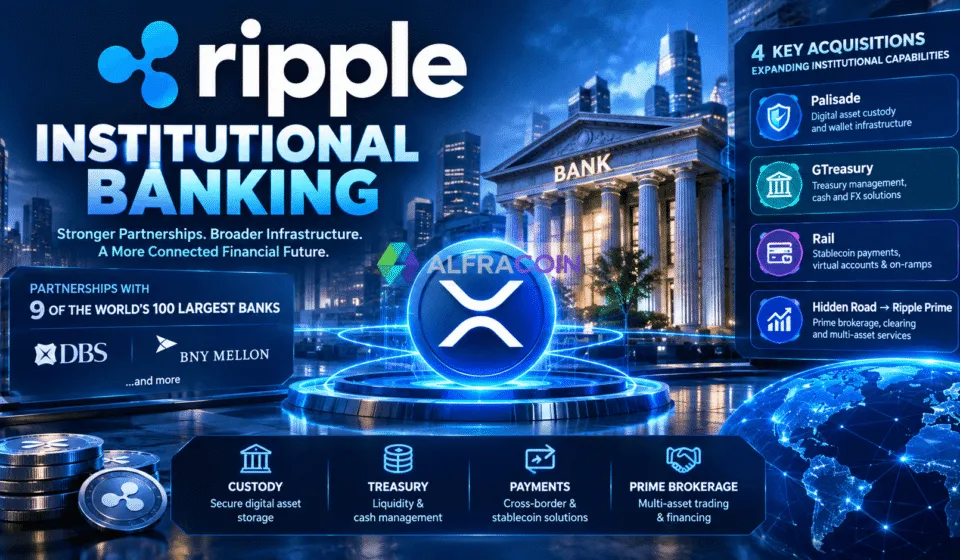
Ripple Institutional Banking Expands
Ripple institutional banking expands through nine bank ties and four acquisitions spanning custody, treasury, payments and brokerage.
- Ripple’s nine bank relationships broaden its presence across traditional financial institutions and institutional banking infrastructure.
- Four acquisitions added custody, treasury management, stablecoin payments and prime brokerage capabilities to Ripple’s business.
- XRP and XRPL remain part of Ripple’s broader ecosystem, while direct token usage varies across institutional services.
Ripple institutional banking is expanding through major bank relationships and acquisitions, adding custody, treasury, payments and prime brokerage capabilities across traditional financial markets.
Institutional banking reach expands
CB Insights identified Ripple among crypto firms targeting traditional banking infrastructure. Its research says Ripple formed nine major-bank relationships since 2023. The relationships include DBS Bank and BNY Mellon, according to the report.
AllinCrypto cited the findings while connecting Ripple’s expansion with XRP and XRPL. The post described Ripple as building infrastructure within established financial markets. However, the reported relationships cover services beyond direct XRP usage.
CB Insights also included Coinbase and Circle within this broader institutional banking trend. The three companies each formed more than 50 relationships during 2025. Their approaches span payments, brokerage, stablecoins, custody and financial infrastructure.
The data places Ripple within a wider shift across financial services. Crypto-native companies increasingly provide infrastructure for traditional financial institutions. Banks are also exploring blockchain alongside established financial networks.
Four acquisitions expand Ripple’s capabilities
Ripple acquired Palisade in November 2025, expanding its digital asset custody capabilities. Palisade provides wallet infrastructure for fintechs, corporates and crypto-native companies. Its services include transaction support, wallet provisioning and on- and off-ramps.
GTreasury added corporate treasury technology through a $1 billion acquisition. The platform supports cash management, foreign exchange exposure, payments, risk management and compliance. Ripple announced the transaction in October 2025.
Rail expanded Ripple’s presence in stablecoin-powered business payments and virtual accounts. Ripple agreed to acquire Rail for $200 million in August 2025. Rail provides cross-border payments, stablecoin on-ramps and transaction infrastructure.
Hidden Road became Ripple Prime after Ripple completed its $1.25 billion acquisition. The business provides institutional brokerage, clearing and financing across multiple asset classes. Ripple later reported that Ripple Prime’s business had tripled since the announcement.
XRP remains part of the broader ecosystem
Together, the acquisitions cover custody, treasury, payments, liquidity and institutional trading. Ripple has described its wider strategy as a connected digital asset infrastructure platform. The businesses can also operate across different financial workflows.
Ripple’s infrastructure includes XRP, XRPL and its RLUSD stablecoin. Ripple Prime uses RLUSD as collateral across certain prime brokerage products. BNY Mellon serves as RLUSD’s primary reserve custodian, according to Ripple.
XRP was trading at about $1.50 on September 28, 2026, according to CoinMarketCap. The asset had declined roughly 2% over the preceding 24 hours.
The reported expansion does not mean every service requires XRP. Ripple’s banking relationships and acquisitions measure institutional reach and infrastructure growth. Direct XRP usage remains a separate metric from those corporate developments.