

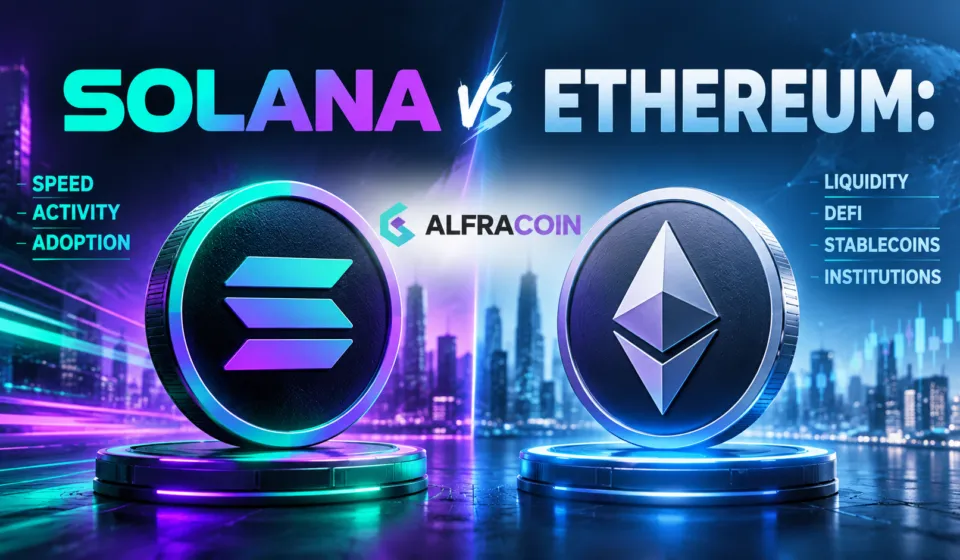
Solana vs Ethereum: The Value Capture Debate
Solana vs Ethereum centers on speed, liquidity, DeFi depth, stablecoins, and settlement as both networks compete for crypto value.
- Solana is gaining traction through speed, trading activity, and consumer applications, while Ethereum retains deeper financial infrastructure.
- Ethereum’s liquidity, stablecoins, Layer-2 ecosystem, and institutional infrastructure create a broader financial settlement network.
- The debate extends beyond transaction activity, focusing on whether Solana can capture value across crypto’s wider financial stack.
Solana vs Ethereum is increasingly becoming a debate about economic value, not transaction speed alone. Solana continues gaining activity across trading and consumer applications, while Ethereum retains deep liquidity and settlement infrastructure.
Solana Builds Momentum Through Network Activity
Ethereum Daily recently shared a post citing Multicoin Capital’s co-founder, who argued that Solana could eventually surpass Ethereum. The post points to Solana’s speed, trading activity, user adoption, and growing consumer applications. It also suggests developers and companies may prefer Solana as a powerful execution layer.
Solana has built considerable traction across trading-focused applications and consumer products. Its performance allows applications to process activity quickly and efficiently. That combination has helped attract users seeking responsive blockchain experiences.
Developer adoption forms another part of the argument surrounding Solana. Companies may favor networks offering strong execution and straightforward application development. Continued developer migration could therefore expand Solana’s application base.
As of writing, market prices also show the scale of both networks. SOL trades around $116.97, according to current Investing.com data. ETH trades around $2,712.95, with both assets experiencing recent market movement.
Ethereum Retains Deep Financial Infrastructure
Ethereum’s position extends beyond activity directly recorded on its mainnet. The figures cited by Ethereum Daily place Layer-1 TVL near $54 billion. Its stablecoin holdings are estimated at roughly $146 billion.
That capital supports lending, derivatives, decentralized exchanges, and collateral markets. Consequently, Ethereum functions as infrastructure for several major financial applications. Liquidity also allows different protocols to interact through shared pools of capital.
Ethereum’s Layer-2 ecosystem adds another dimension to its financial structure. Base, Arbitrum, Optimism, and other networks extend Ethereum’s execution environment. These networks settle activity through Ethereum while supporting additional applications and transactions.
Stablecoins further strengthen Ethereum’s position across decentralized finance. They facilitate trading, lending, payments, and collateral management across protocols. This established liquidity gives Ethereum a financial footprint extending beyond simple transaction counts.
The Competition Centers on Value Capture
The central question is how blockchain activity translates into economic value. Solana’s rising usage demonstrates strong demand for fast execution and consumer applications. Ethereum’s infrastructure demonstrates deeper connections with capital and financial markets.
The two networks therefore compete through different strengths within the cryptocurrency economy. Solana emphasizes high-performance execution and expanding user activity. Ethereum combines settlement, liquidity, stablecoins, DeFi, and Layer-2 infrastructure.
Institutional infrastructure adds another layer to Ethereum’s established position. Custody, staking, tokenized assets, ETFs, and institutional DeFi have developed around its ecosystem. These connections create financial relationships that extend across multiple market segments.
The debate consequently extends beyond which network processes more transactions. Solana would need broader financial adoption to replace Ethereum’s existing role. That includes deeper liquidity, greater collateral use, stronger stablecoin activity, and wider settlement adoption.